Introduction: Secrets on the Battlefield
Imagine you’re a Spartan general during the Peloponnesian War. You need to send urgent orders to your troops—but if the enemy intercepts your message, disaster could strike. Enter the scytale, a simple yet ingenious device that allowed the Spartans to keep military communications secret.
The scytale is one of the earliest known encryption tools and a powerful example of how cryptography has always been tied to survival, strategy, and mathematics. Though deceptively simple, it introduced the concept of transposition ciphers, laying the groundwork for methods still in use centuries later.
Origins of the Scytale
The word scytale (sometimes written skytale) comes from the Greek word skytalē, meaning “staff” or “baton.” The device itself was nothing more than a cylindrical rod paired with a strip of parchment, cloth, or leather. Yet in the hands of the Spartans, one of the fiercest militaries of the ancient world, it became a vital cryptographic tool.
The earliest records of scytale use date back to the 5th century BCE, during the Peloponnesian War. Spartan generals needed a secure way to send commands across long distances without revealing their plans to rival city-states like Athens. The scytale met that need: it was portable, efficient, and required no elaborate training to use.
How the Scytale Worked
Unlike substitution ciphers (such as the later Caesar cipher), the scytale was based on transposition—rearranging letters into a scrambled sequence. Here’s how it worked:
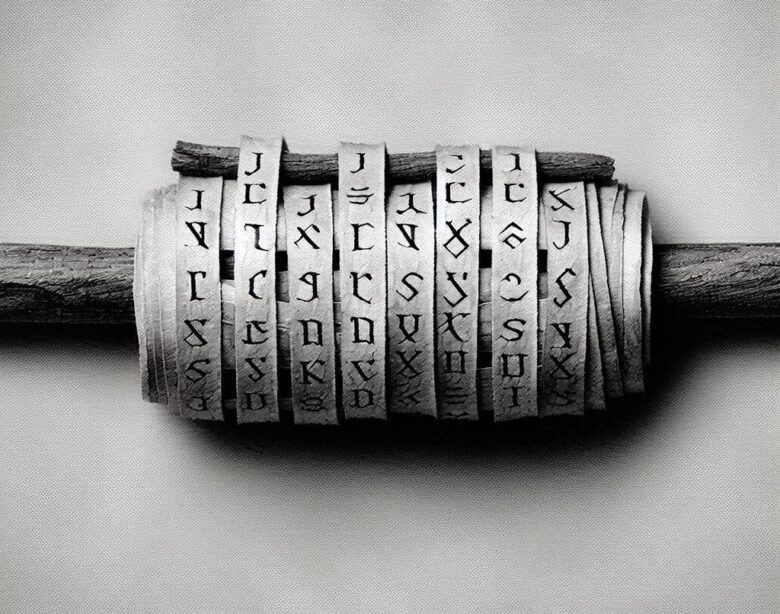
- The sender wrapped a strip of parchment or leather tightly around a cylindrical rod of fixed diameter.
- They wrote the message along the length of the rod, across the aligned strip.
- When unwrapped, the message appeared as jumbled letters—meaningless to anyone without the right rod.
- The recipient, using an identical rod, rewrapped the strip to reveal the original message.
For example, the plaintext message “ATTACK AT DAWN” might look like an incomprehensible jumble when unwrapped. Only by winding it around the correct rod would the letters realign.
This elegant system demonstrated a key principle: security relied on both parties possessing the same key—in this case, rods of identical diameter.
Strengths and Weaknesses
For its time, the scytale offered practical advantages:
- Lightweight and portable: Soldiers could easily carry it.
- Fast and efficient: Encoding and decoding took only moments.
- Key-based security: Only someone with the right rod could read the message.
But it had clear limitations:
- Vulnerability: If an enemy guessed or built a rod of the correct size, the code was broken.
- Simplicity: Compared to later ciphers, the scytale offered only modest protection.
Even so, the scytale gave the Spartans an edge by making intercepted messages far less useful to their enemies.
The Scytale in Spartan Military History
The Spartans were famous for their discipline, secrecy, and tactical innovation. The scytale was perfectly suited to their needs. Historical sources suggest it was used to send orders about troop movements, battle strategies, and tactical plans.
While the scytale is most closely associated with Sparta, it’s possible that other Greek city-states experimented with similar tools. Either way, the scytale’s role in warfare highlights an enduring truth: cryptography and military power have always gone hand in hand.
A Place in the History of Cryptography
The scytale is more than a clever military gadget—it represents one of the earliest examples of systematic cryptography. By formalizing a transposition cipher, it laid the foundation for methods that would evolve across cultures and centuries.
Other early ciphers include:
- The Atbash cipher (used by the ancient Hebrews), a substitution method.
- The Caesar cipher (1st century BCE), where letters are shifted by a fixed number.
Together, these ancient methods show humanity’s early fascination with secrecy—and their intuitive use of mathematical ideas like patterns, permutations, and modularity.
Legacy: From Rods to Algorithms
Though simple, the scytale anticipates principles still at the heart of cryptography:
- Shared keys: Both sender and receiver must have the same “key” to decode the message.
- Transposition: Rearranging elements to obscure meaning.
- Balance of security vs. usability: Even today, cryptographers grapple with this trade-off.
Modern encryption methods, like block ciphers, still use transposition techniques—though now applied digitally in sophisticated layers of substitutions and permutations. The idea that began with a wooden rod lives on in computer algorithms.
The Scytale in Modern Culture and Education
The scytale remains a popular teaching tool. Teachers often recreate it with paper strips and dowels to introduce students to the basics of encryption. Its straightforward mechanics make it a great gateway into the mathematics of cryptography.
It has also appeared in novels, films, and games focused on espionage and ancient warfare, cementing its status as an iconic symbol of early secret communication.
Conclusion: A Simple Device with Lasting Impact
The scytale may seem quaint compared to today’s cryptographic algorithms, but its significance is undeniable. It represents one of the first times humanity formalized the process of hiding information. For the Spartans, secrecy meant survival. For us, it means secure banking, private communication, and safe digital life.
From Spartan rods to RSA encryption, the thread of cryptography stretches across history. The scytale stands as a reminder that even the simplest ideas can spark revolutions in mathematics, science, and security.
Please Visit Our Sponsors:
We only support vendors that we use ourselves in our home. The links below are our own links or affiliate links but know that we use all of these now, or have in the past. As the author/creator of this blog, I also tutor mathematics on Wyzant, sell on Etsy, create content on TpT, and learn Korean on Rosetta Stone.